The Lab Report is our monthly research letter from Refinery Fitness in Rhinebeck, NY. Each issue takes one topic from the exercise-science literature and translates it into training you can actually use. Everything is cited — sources are linked at the bottom.
The numbers nobody tells you about turning 50
Roughly one in two adults over 50 already has low bone mass, and by their eighties about one in four women has osteoporosis. The loss isn't gradual for women — around menopause it accelerates to about 2% a year for roughly three years, taking close to a tenth of your skeleton in a decade. Men lose bone too, just slower and later. And here's the part that matters: bones are not concrete. They are living tissue that rebuilds itself in response to load — which means the losses are negotiable. This month: what the research says actually defends your skeleton.
Why bone is a training problem
Last issue we called muscle your retirement account. Bone is the house that account lives in. A fragility fracture — a hip broken in a simple fall — is one of the most independence-ending events in older life, and most of those fractures start with a fall, not with the bone itself. That's why this issue has two heroes: the training that keeps bone dense, and the training that keeps you upright. The honest headline from the research: exercise preserves bone and modestly builds it, and research showed programmes built on balance and functional training cut falls by about a quarter. Nobody honest will promise you a new skeleton. What training offers is a slower decline and a much better chance of staying on your feet.
The protocol: what the science actually says
1. Walk briskly — it counts more than we used to say. In a research review of 124 trials and more than 18,000 adults over 40, research showed brisk walking or jogging produced some of the most favourable bone results of any exercise tested — at the spine, at the femoral neck, and at the total hip, where it was the only type of exercise with a clear benefit. The dose that mattered was about 600 MET-minutes a week for the hip — roughly 2 to 3 hours of brisk walking or jogging a week. Ordinary strolling was not what was tested; the pace has to be brisk. One honest qualifier: that review covered adults over 40 generally, and it grouped brisk walking with jogging. In trials of people who already have low bone density, research showed walking on its own preserved bone at the hip but did not build it at the spine. So treat brisk walking as the base of the programme — daily and non-negotiable — not the whole programme. The building happens in points 2 to 4.
2. Combine your training. In that same review, research showed combined aerobic-plus-resistance training matched brisk walking for the spine benefit. Lifting on its own helped too — at the femoral neck in that review, and at the spine and total hip in analyses of lifting-only trials — but the combination was the more reliable play overall, and the guidelines written for people with low bone density put combined training at the centre. In practice: lift, and keep your brisk walking — don't trade one for the other.
3. For lifting alone, intensity is the difference. In a year-long trial of 324 adults over 50 with low bone density, training twice a week, research showed high-intensity progressive lifting modestly increased spine density, while moderate-intensity lifting produced no density change at all — and neither intensity improved the hip. The changes were small, and the trial reported only minor expected adverse events, with no fractures caused by the exercises. Two earlier trials in women with osteopenia and osteoporosis point the same way. In one, eight months of supervised heavy lifting plus impact work, twice a week, improved spine density by about 3% while the comparison group lost bone. In the other, the same style of training improved spine density by about 2%, while a gentle Pilates-based programme barely moved it. Across both, the safety record was strikingly clean — minor aches, no fractures caused by the training — because every session was supervised and the loads were earned gradually. The fine print matters: this was progressive, supervised-style training built up over months, not a dare to max out on day one.
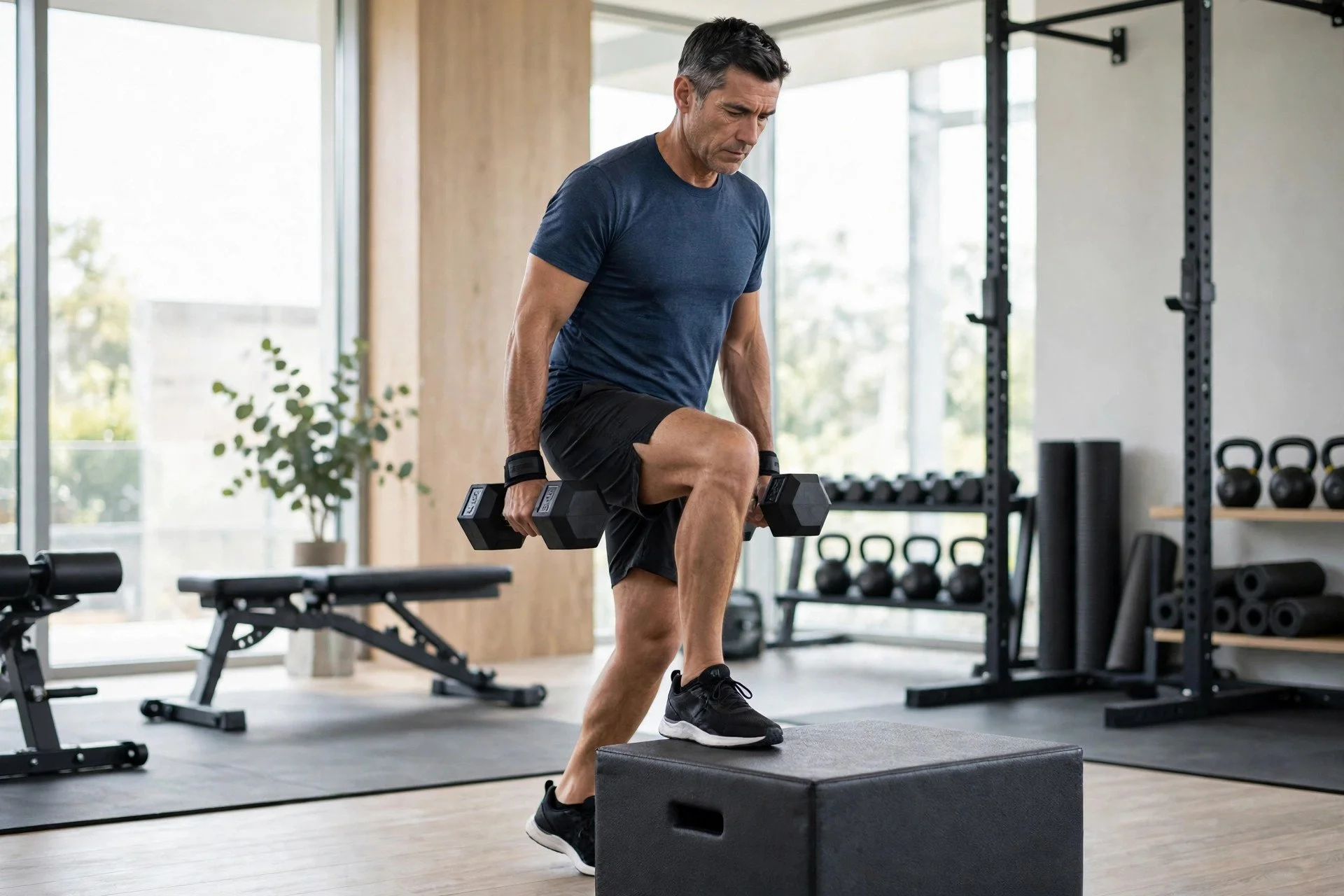
4. Add impact, in small doses. Bone responds to high-rate loading: heel drops, stomps, hops, small jumps — most days, in short bouts, scaled to your joints and your history. One boundary matters: if you have had a vertebral fracture, or more than one fragility fracture, keep impact at brisk-walking level — no jumps — until a clinician clears more. Everyone else builds up gradually.
5. Train balance like it matters — it's the falls insurance. Research showed exercise programmes built on balance and functional training cut falls by about a quarter, and balance-plus-resistance training by about a third. Two hours a week, accumulated in short bouts: tandem stands, single-leg work, stepping drills, sit-to-stands.
6. Give it a year, and don't over-read your DXA. Bone remodels slowly. The year-long lifting trial above is the right timescale — short trials rarely show anything. And a 1–2% wiggle on a yearly scan is usually inside the machine's measurement error, not a verdict on your programme. Rescan on the same machine, no sooner than a year or two, and judge the training by strength, balance, and posture in the meantime.
7. Respect the spine rules. If you have osteoporosis or a past vertebral fracture: no loaded, end-range bending and twisting of the spine — weighted crunches and rounded-back lifting are out, neutral-spine hinging is in. And train the other direction on purpose: back-extension work — the muscles that hold you upright — is part of the prescription, for posture now and fracture protection later. Get clinician clearance and coach supervision before heavy work. For healthy osteopenia, the rules are guidance, not fear.
What the science retired
Plenty of well-meant advice didn't survive — and one piece of our own early draft didn't either. We used to say walking does nothing for density; the newest review says brisk walking is one of the best-supported options there is, so that claim is gone. What still doesn't hold up: swimming and cycling as bone builders — non-weight-bearing exercise doesn't load the skeleton the same way. And the mirror-image myth — "heavy lifting is automatically dangerous when your bones are thin" — is not what the year-long trial found when training was progressive and properly dosed. Bone doesn't want to be wrapped in cotton. It wants a reason to stay. And one more piece of honesty: if you have established osteoporosis, training is a partner to medication, not a replacement for it — the guidelines are unanimous on that.
Supplement Spotlight: Vitamin D + K2
Loading is the stimulus, but bone needs its raw materials too. Vitamin D helps you absorb calcium; K2 helps direct that calcium into bone. Short Hudson Valley winters leave many of us low on D without knowing it — worth getting yours checked.
Come try it in the gym
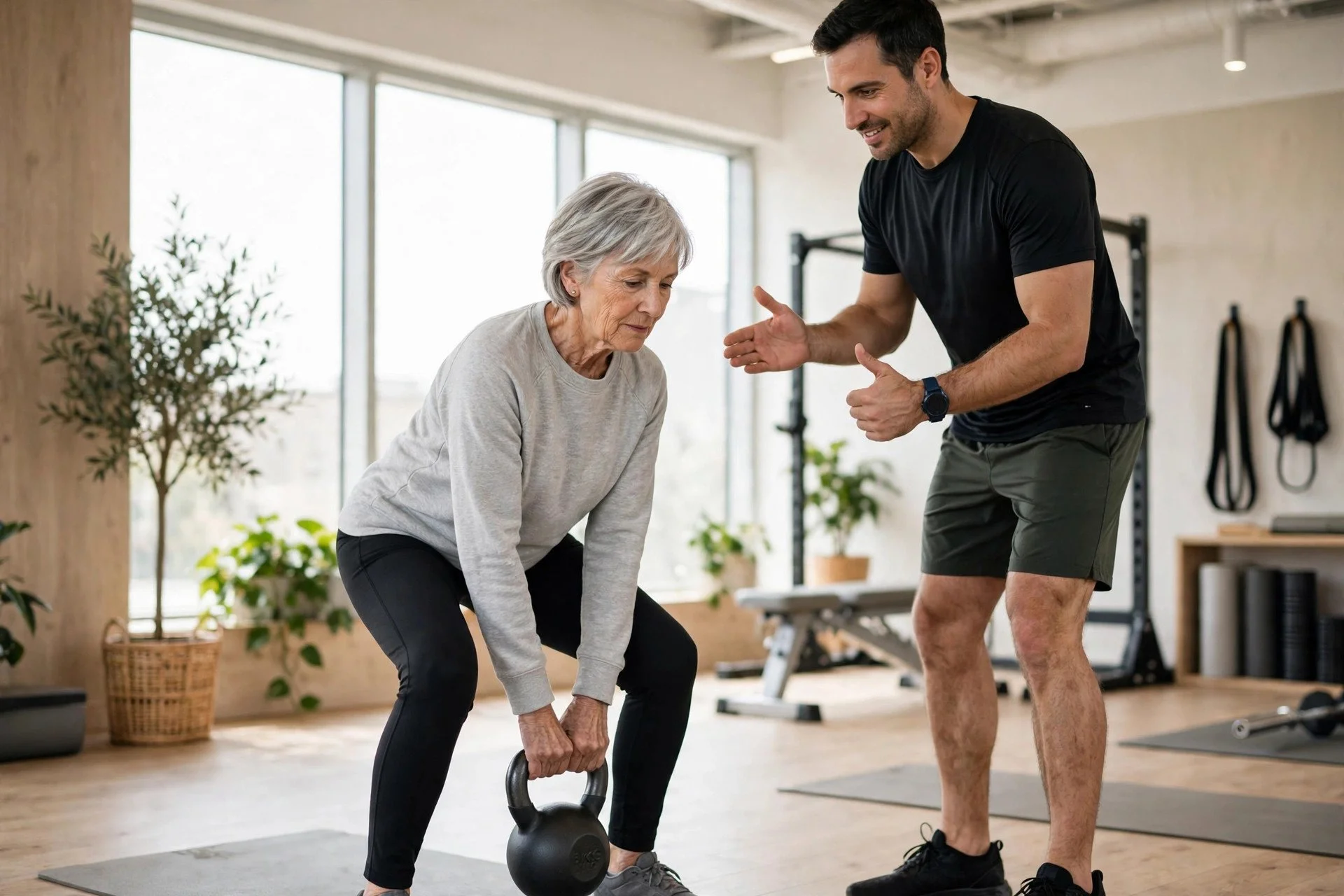
Reading about load is one thing — hinging with a barbell, coached, is another. Come into the gym and try it: we'll teach you the lifts that load your skeleton safely — deadlift, squat, press — with spine-sparing technique from day one.
— Navin, Refinery Fitness, Rhinebeck NY
A quick note
This newsletter is education, not medical advice, and it isn't a substitute for your own clinician's guidance. If you have osteoporosis, low bone density, or any other condition that affects how you should train, check with your doctor or health care professional about what types of training are right for you before starting — or changing — a program.
Sources
Giangregorio LM, et al. Finding the Optimal Resistance Training Intensity for Your Bones (FORTIFY Bones): a randomized controlled trial. Presented at ASBMR 2026. Trial protocol on PubMed
Finkelstein JS, et al. Bone mineral density changes during the menopause transition (SWAN). Journal of Clinical Endocrinology & Metabolism, 2008. Read the study
Sherrington C, et al. Exercise for preventing falls in older people living in the community. Cochrane Database of Systematic Reviews, 2019. Read the review
Beck BR, et al. ESSA position statement on exercise prescription for the prevention and management of osteoporosis. Journal of Science and Medicine in Sport, 2017. Read the statement
Brooke-Wavell K, et al. Strong, steady and straight: UK consensus statement on physical activity and exercise for osteoporosis. British Journal of Sports Medicine, 2022. Read the statement
Bae S, et al. Position statement: exercise guidelines for osteoporosis management and fall prevention. Journal of Bone Metabolism, 2023. Read the statement
Morin SN, et al. Clinical practice guideline for management of osteoporosis and fracture prevention in Canada: 2023 update. CMAJ, 2023. Read the guideline
Watson SL, et al. High-intensity resistance and impact training improves bone mineral density and physical function in postmenopausal women with osteopenia and osteoporosis: the LIFTMOR randomized controlled trial. Journal of Bone and Mineral Research, 2018. Read the study
Kistler-Fischbacher M, et al. A comparison of bone-targeted exercise with and without antiresorptive bone medication (MEDEX-OP). Journal of Bone and Mineral Research, 2021. Read the study
Shojaa M, et al. Effects of dynamic resistance exercise on bone mineral density in postmenopausal women: a systematic review and meta-analysis. Osteoporosis International, 2020. Read the review
Martyn-St James M, Carroll S. Meta-analysis of walking for preservation of bone mineral density in postmenopausal women. Bone, 2008. Read the review